

- Folder Determine Cause of Poisoning
- Views 3003
- Last Updated 26/12/2025
Blister beetles are insects resembling stink bugs, traditionally used in folk medicine to treat boils and ulcers, but they contain the highly toxic compound cantharidin, which can cause skin blistering and, if ingested, lead to gastrointestinal burning, inflammation of the genitourinary system, neurological disorders, coma, and even death within 24 hours.
1. The situation of food poisoning related to blister beetles in Vietnam
In recent times, several cases of food poisoning related to blister beetles have been reported nationwide, as follows:
In May 2024, in Lao Cai Province, Bao Thang District General Hospital admitted a male patient presenting with numbness of the lips and tongue, abdominal pain, diarrhea, vomiting, and painful urination. It was reported that in addition to dishes such as dog meat cooked with plum sauce, dog bone soup with enoki mushrooms, and boiled water spinach, the patient also consumed a dish made from insects stir-fried with dried shallots. Upon verification by the Lao Cai Department of Health, the insects were identified as blister beetles.
In June 2024, in Yen Bai Province, Military Central Hospital 108 admitted a case of poisoning caused by consuming fried blister beetles. The male patient was hospitalized in a condition of severe fatigue, weakness of the limbs, rhabdomyolysis, and acute renal failure.
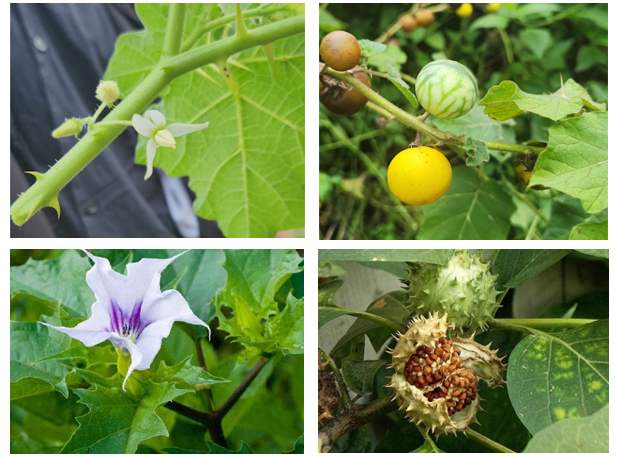
In May 2024, in Yen Bai Province, Bach Mai Hospital admitted three patients with poisoning after consuming blister beetles, presenting with symptoms such as nausea, vomiting, abdominal pain, abdominal distension, painful urination, difficulty urinating, and in some cases hematuria. One of the three patients reported that after hearing that blister beetles were edible, and seeing that this insect was abundant on sweet leaf plants and groundcherry plants, he assumed it was safe and collected the insects to prepare a meal for everyone to eat.
In August 2024, in Gia Lai Province, Gia Lai Provincial General Hospital admitted a male patient with very severe poisoning after eating ten blister beetles. After consumption, the patient developed symptoms of abdominal pain and vomiting and was brought to the hospital in a condition of profuse sweating, weakness of the limbs, and dark red urine. The patient was subsequently transferred to the intensive care and toxicology unit but did not survive.
In September 2024, in Lai Chau Province, a male patient was hospitalized with chest tightness, shortness of breath, nausea, and generalized numbness and weakness to the extent that he was unable to walk; his heart rate was markedly increased and blood pressure dropped to 90/60 mmHg. Lai Chau Provincial General Hospital reported that the patient had previously consumed two blister beetles. Approximately half a day later, he developed chest tightness, nausea, abdominal bloating, and indigestion, prompting hospital admission.
According to the analytical results of the National Institute for Food Control, all of these poisoning cases were determined to be caused by the active compound cantharidin contained in blister beetles.
2. Characteristics, morphology, and toxins
2.1.2. Characteristics, morphology
Blister beetles (scientific names: Mylabris phalerata or Mylabris cichorii) belong to the insect family Meloidae. They are also known by other names such as fire beetles, bean beetles, ban mieu, or ho trung. This is a group of brightly colored beetles commonly found in many regions of Asia, including Viet Nam.
Blister beetles have a relatively striking appearance (Figure 1). They typically have a slender, elongated body, with an average length ranging from 1 to 3 cm, and some species may be larger. Their outer shell is hard and glossy, with characteristic colors that are usually metallic black or interspersed with yellow, orange, or red markings. This combination of colors makes blister beetles very conspicuous and easy to distinguish from many other beetle species. Some species have transverse stripes on their wings, which create a noticeable shimmering effect when they move under sunlight.
The head of the blister beetle is relatively small compared to its body and is equipped with a pair of long, clearly segmented antennae that help with orientation and food searching. Their mouthparts are of the chewing type, specialized for feeding on young leaves. The thorax is well developed and connected to hardened forewings (elytra), which serve to protect the thin, transparent hindwings beneath. When flying, the beetles extend their membranous wings for movement; however, their flight ability is not as fast or agile as that of some other beetle species.
Blister beetles have three pairs of legs, each composed of several small segments, enabling them to firmly grip leaf surfaces and plant stems. This feature also allows them to climb easily and move from one plant to another in search of food or suitable sites for reproduction.
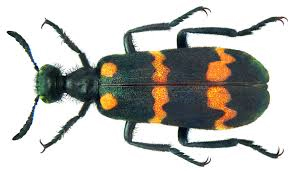
Figure 1. Images of blister beetles
Regarding their habitat, blister beetles are commonly found in tropical and subtropical climates, and are particularly prevalent in countries such as China, India, Japan, and South Korea, as well as in the northern provinces of Viet Nam. They typically inhabit agricultural crops including rice, maize, beans, wheat, and various other cultivated plants. Due to their leaf-feeding behavior, blister beetles are sometimes considered agricultural pests, as large populations can reduce crop yields.
This species is most active during the summer, when hot and humid weather conditions are favorable for reproduction. During the daytime, they usually hide under leaves or plant stems and show limited movement. In the late afternoon or at night, they become more active and emerge to feed. The life cycle of blister beetles is quite distinctive: the larvae initially live as parasites on the eggs or larvae of other insects, while the adult stage becomes leaf-feeding. This characteristic allows them to influence both natural ecosystems and agricultural production.
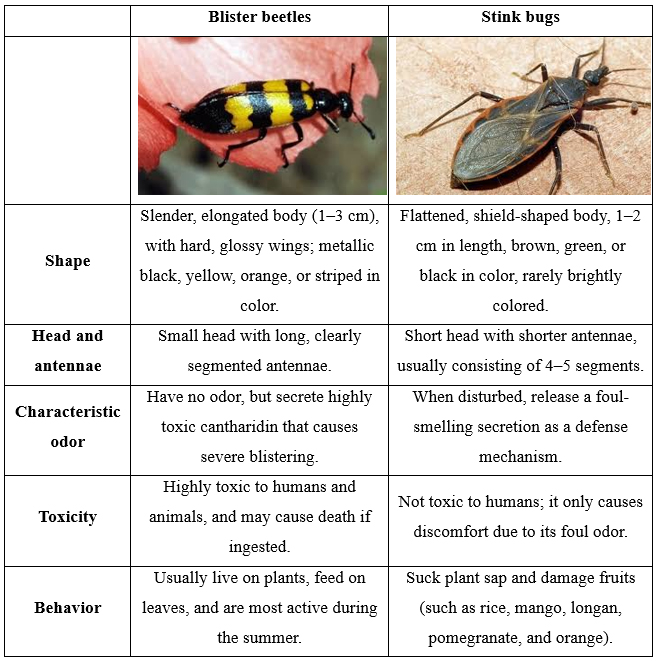
Blister beetles are easily confused with stink bugs, which are also common insects known for their unpleasant odor. Although both insects are widespread in rural areas and can cause damage to crops, blister beetles and stink bugs differ in many characteristics (Table 1).
Table 1. Distinguishing blister beetles from stink bugs
2.2 Toxins of blister beetles
What makes blister beetles particularly dangerous insects is the toxin cantharidin (Figure 2). This is an organic compound belonging to the terpenoid group, secreted by the blister beetle, with especially high concentrations in the abdominal cavity. Cantharidin exists as colorless, odorless, and tasteless crystals, but it has very strong corrosive properties.
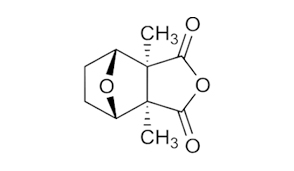
Hình 2. Cantharidin - Toxins secreted by blister beetles
Cantharidin causes harm mainly by strongly irritating the mucous membranes and the skin:
+ Upon contact with the skin, it disrupts the epidermal layer, causing blistering and burning sensations.
+ When entering the body through the gastrointestinal tract, it directly attacks the mucosa of the mouth, esophagus, stomach, and intestines, leading to inflammation, ulceration, and hemorrhage.
+ Cantharidin also has a particular affinity for the kidneys, causing renal tubular necrosis and impairment of blood filtration function. In addition, at high doses, this compound may affect the nervous and cardiovascular systems.
The median lethal dose (LD₅₀) of cantharidin in animals is approximately 0.5 mg/kg body weight. In adults, ingestion of only 30–50 mg of pure cantharidin (equivalent to the amount contained in 6–7 dried blister beetles) can be fatal. Children, pregnant women, and individuals with kidney or cardiovascular diseases are more susceptible to severe poisoning.
2.3. Symptoms of poisoning
People poisoned by cantharidin typically present with the following signs and symptoms:
+ Skin contact: Redness, burning sensation, blistering, and skin ulceration.
+ Ingestion (Oral route): Burning pain in the lips and throat, difficulty swallowing; followed by severe abdominal pain, nausea, and hematemesis (vomiting blood).
+ Urinary tract: Painful urination (dysuria), bloody urine (hematuria), and urinary retention.
+ Severe complications: Acute kidney failure, arrhythmia, shock, and potential fatality
Onset of symptoms typically occurs within 1–4 hours after exposure or ingestion. The condition progresses rapidly and can become difficult to manage without timely emergency medical intervention
3. Prevention and treatment of blister beetle poisoning
3.1. Treatment of Poisoning
In case of accidental contact with or ingestion of blister beetles, rapid action must be taken according to the Ministry of Health's Guidelines for the Diagnosis and Management of Poisoning as follows:
- If skin contact occurs:
- Immediately wash the affected area with plenty of clean water and soap.
- Do not scratch or rub the area to prevent spreading the lesions.
- A mild antiseptic solution may be applied to limit infection.
- If ingested or if gastrointestinal poisoning is suspected:
- Do not induce vomiting, as this can cause further damage to the esophageal mucosa.
- Drink plenty of water to dilute the toxins. Milk or raw egg whites may be consumed (the protein helps partially reduce toxin absorption).
- Immediately take the patient to the nearest medical facility for specialized treatment.
It is particularly important to notify health authorities and transport the patient to a hospital promptly.
3.2. Prevention of blister beetle poisoning
Dưới đây là bản dịch giữ nguyên định dạng các dấu đầu dòng của bạn:
To minimize the risk of blister beetle poisoning, the following principles should be observed:
- Do not catch blister beetles with bare hands: The toxins can adhere to the skin, causing blistering and burning sensations. If contact is necessary, thick gloves must be worn and hands washed thoroughly afterward.
- Do not eat or use blister beetles as home remedies: Many poisoning cases occur because people arbitrarily dry, grind into powder, or soak the beetles in alcohol for consumption.
- Ensure safe storage: If harvested for medicinal purposes, they must be kept separate with clear warning labels to prevent confusion by children or others.
- Raise community awareness: Educate the public about the high toxicity of this insect species to avoid "trial use" based on word-of-mouth.
4. Propaganda activities to prevent blister beetle poisoning
In recent years, the National Institute for Food Control (NIFC) has identified the causes of poisoning cases related to blister beetles. With the aim of contributing to the reduction of food poisoning cases caused by blister beetles in particular and natural toxins in general, the National Institute for Food Control regularly implements activities to investigate and determine the causes of food poisoning, as well as communication efforts for poisoning prevention. Communication activities regarding the prevention of blister beetle poisoning will contribute to limiting poisoning cases in the future.
In the task of investigating and determining the causes of food poisoning outbreaks, the accurate analysis and detection of natural and chemical toxins—specifically cantharidin and other toxicants in general—is of particular importance for management, risk warning, and public health protection. The National Institute for Food Control, the highest-level food testing unit under the Ministry of Health, was established under Decision No. 376/QD-TTg dated March 23, 2009, by the Prime Minister. It is a testing unit designated for state management by the Ministry of Health, the Ministry of Agriculture and Rural Development, and the Ministry of Industry and Trade, and serves as the national arbitration testing unit in the field of food quality and safety. With a standard laboratory system equipped with modern analytical techniques and a team of highly qualified staff and experts, the Institute has the full capacity to analyze, identify, and quantify dangerous toxins, effectively serving food poisoning investigation and food safety management. Besides its state management duties, the Institute also provides food testing services upon request, committed to providing customers with honest, accurate, efficient, and reputable results.
Author: Kieu Van Anh
Laboratory of Food Toxicology and Allergens - National Institute for Food Control
REFERENCES
1. Nguyen Tan Trong (2008), Medical and veterinary entomology, Vietnam Education Publishing House.
2. Do Huy Bich (2006), Medicinal plants and medicinal animals in Vietnam, Science and Technics Publishing House.
3. Ministry of Health (2015), Guidelines for diagnosis and treatment of poisoning.
4. Vu Van Chi (2012), Dictionary of Vietnamese medicinal plants, Medical Publishing House.
5. Nikfarjam, L., Farzaneh, P., & Pourghadamyari, H. (2017), Toxicological Effects of Cantharidin: A Comprehensive Review, Journal of Applied Toxicology, 37(8), 1034–1046.