

- Folder Internal News
- Views 250
- Last Updated 11/06/2026
On June 7, 2026, the National Institute for Food Control (NIFC) attended the Food Safety Forum within the Food Systems framework at Thai Nguyen University of Agriculture and Forestry (TUAF). Under the theme “One Health solutions for safer food,” the Institute contributed valuable information aimed at reducing the food safety burden.
In observance of World Food Safety Day, the forum of Food Safety within the Food System convened participants from diverse sectors and disciplines to exchange scientific evidence and discuss practical, scalable solutions for enhancing food safety in Vietnam. The forum garnered widespread attention from national and international organizations, convening representatives from government authorities, international organizations, research institutions, universities, and industry to exchange perspectives on strategies and solutions for strengthening food safety
In her opening remarks, Dr. Phan Thi Hong Phuc, Vice Rector of Thai Nguyen University of Agriculture and Forestry (TUAF), underscored the critical importance of food safety in the context of increasing climate change impacts and disease outbreaks. She further reiterated the pivotal role of higher education institutions in cultivating the next generation of leaders capable of tackling food safety challenges. Following this, Dr. Nguyen Viet Hung, Regional Representative for Asia and Director of the International Livestock Research Institute (ILRI) Asia, presented concerning statistics illustrating the global burden of foodborne diseases, he highlighted that foodborne illnesses affect approximately 866 million people annually worldwide, resulting in an estimated economic loss of USD 647 billion. Food safety failures are estimated to incur an economic burden equivalent to approximately 1% of Vietnam's national GDP.
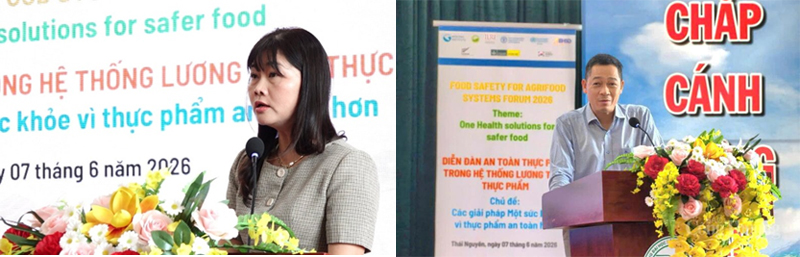
Dr. Phan Thi Hong Phuc, Vice Rector of Thai Nguyen University of Agriculture and Forestry, and Dr. Nguyen Viet Hung, Asia Regional Director of International Livestock Research Institute (ILRI), delivering remarks at the forum
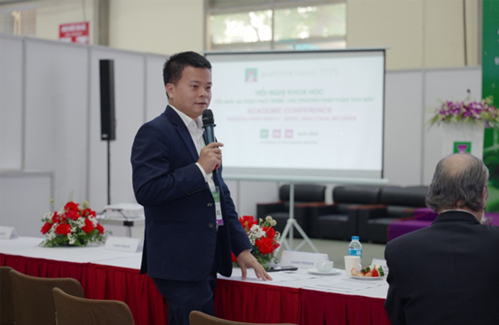
In the first session focusing on food safety risk overviews and policy perspectives, Ms. Vu Thi Thanh An, MSc (Researcher at the Vietnam Center for Food Safety Risk Assessment - VFSA, National Institute for Food Control - NIFC) discussed the role of advanced analytical technologies and digital data application in food safety risk assessment. The presentation further highlighted the Party and the Government directives regarding the unification of a single focal point for food safety management. The National Assembly is expected to revised Food safety Law in its 2026 legislative agenda. Furthermore, the presentation underscored comprehensive digitalization as a urgent requirement to move toward a transparent food safety sector that is harmonized with international standards
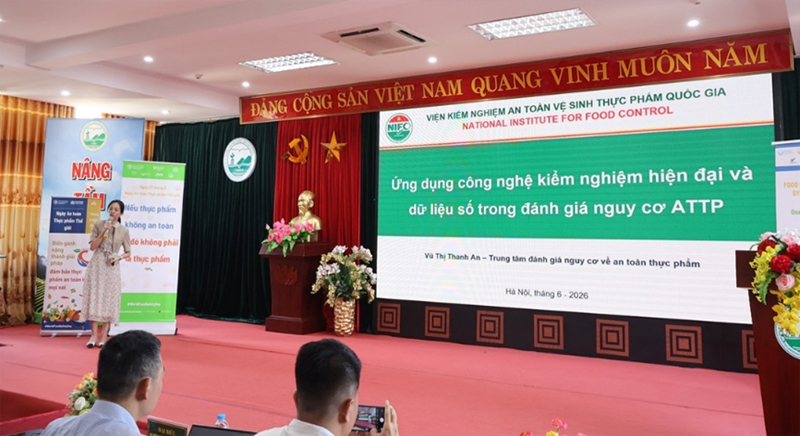
MSc. Vu Thi Thanh An from the VFSA, NIFC shared insights at the forum
Subsequently, Dr. Dang Xuan Sinh from the International Livestock Research Institute (ILRI) delivered a presentation entitled “3-leg stool approach to food safety for capacity building, incentives, enabling environment” as a scientific intervention to reduce the unsanitary practices throughout the meat processing and slaughtering chain. The “3-leg stool” approach is based on three pillars: an enabling environment through co-management arrangements, capacity building by providing equipment such as raised stainless-steel floors and smooth cutting surfaces, and motivation encouragement through hygiene scoring and reward. Implementation outcomes showed promising signs, with intervention facilities recording lower microbial contamination rates than non-intervention facilities.
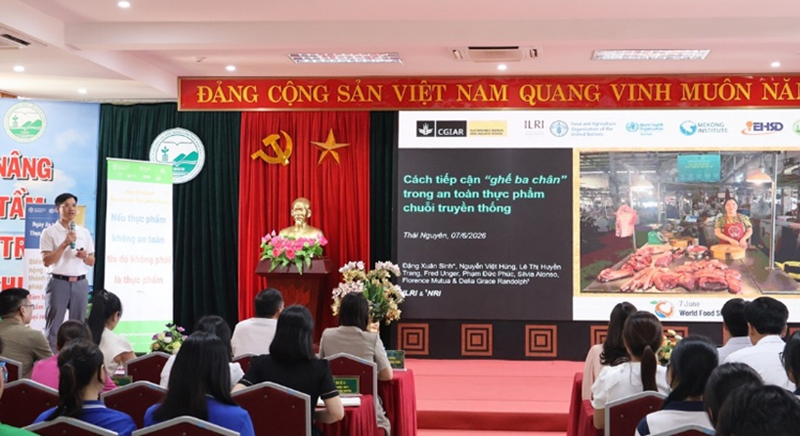
Dr. Dang Xuan Sinh from ILRI presented on the “3-leg stool” approach at the forum.
Additionally, Mr. Dao Ha Trung, Chairman of the Ho Chi Minh City Hi-Tech Association, presented virtually on the “Tick Xanh Trach nhiem” (Responsible Green Tick) digital traceability system currently under implementation in Ho Chi Minh City. The solution applies Blockchain technology and QR codes to manage the journey from farm to school meals. This solution enables schools and parents to scan QR codes on meal trays to verify product origin, thereby helping to restore trust and enabling the rapid recall of products in the event of food safety incidents. This solution not only applies advanced technologies but also addresses the core issue of consumer trust, which has been seriously affected by a series of recent food safety incidents.
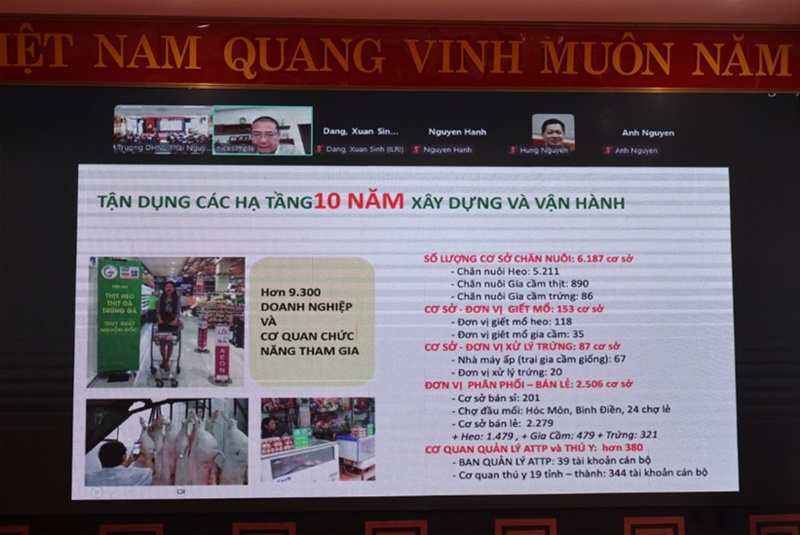
Mr. Dao Ha Trung, Chairman of the Ho Chi Minh City High-Tech Association, presented the achievements in building the food safety system in Ho Chi Minh City over the past 10 years
The centerpiece of the forum was a panel discussion titled “Solutions and approaches to improve food safety management and consumer trust” moderated by Dr. Pham Duc Phuc, Director of the Institute of Environmental Health and Sustainable Development (IEHSD). From the regulatory side, addressing the question of foods labeled as “organic”, Assoc. Prof. Dr. Tran Cao (Deputy Director of NIFC) stated that public trust cannot be based on “rumors” but must be supported by scientific evidence through rapid testing or in-depth laboratory analysis. In addition, he emphasized that the NIFC’s key priority for the coming year is to accelerate the digitalization of its data systems to make the entire process of managing, collecting, and extracting food safety data more efficient and scientific. On the other hand, Dr. Nguyen Viet Hung noted that although Vietnam’s regulations are generally well-developed, enforcement remains limited in practice. During this 'transitional' period, when it is not yet possible to focus entirely on centralized slaughterhouses, practical, low-cost solutions such as raised stainless steel slaughter platforms should be implemented to reduce contamination. He committed that in the coming year, ILRI will intensify efforts to seek technologies that can rapidly reduce microbial contamination in the pork value chain
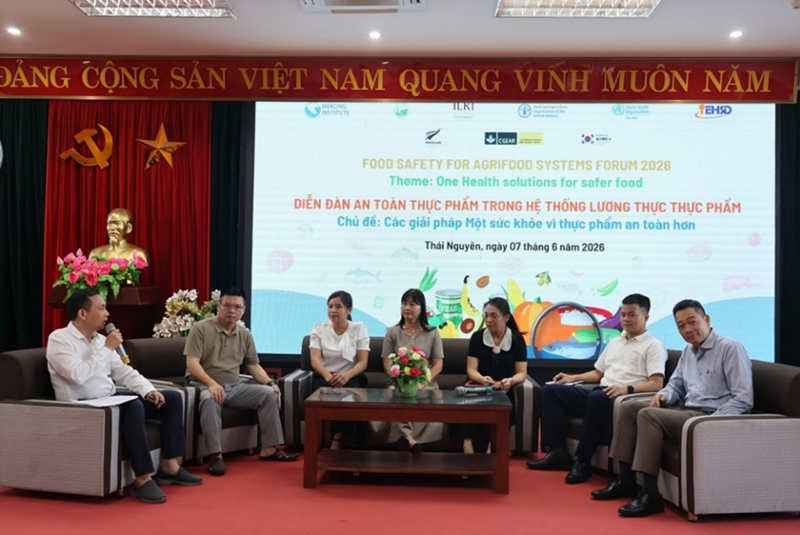
The panel discussion focused on “Solutions and approaches to improve food safety management and consumer trust ”
At the conclusion of the forum, Dr. Pham Duc Phuc announced and presented awards to the winning student teams of the food safety communication product competition. Notably, the competition was not only a scientific playground for students with a science background but also received enthusiastic participation from a group of young school-children with simple yet no less accurate thoughts on food safety issues
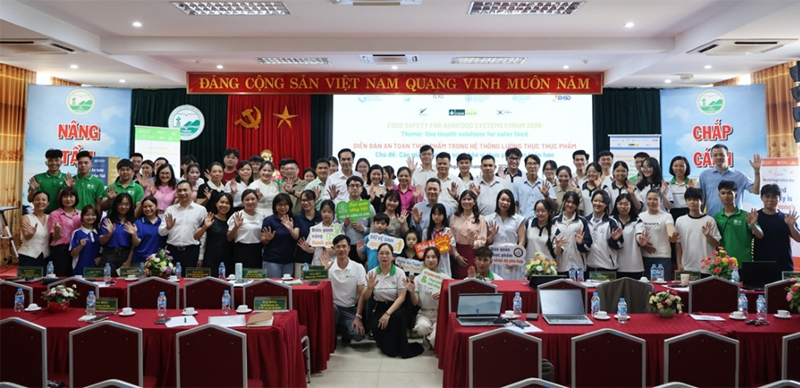
Delegates and students gathered for a commemorative group photo at the forum.
Drawing on insights from the forum, food safety has become more present and authentic-no longer confined to highly academic management measures and analytical techniques, but has become a concern for society as a whole. Modern science and technology, together with advanced approaches, will continue to serve as a solid bridge in the effort to build a food-safe Vietnam.
Written by Vu Thi Thanh An from Vietnam Center for Food Safety Risk Assessment,NIFC.